Wildwood Bayou 2016

Wildwood Bayou 2016

Monday, April 18, 2011

St. Augustine, FL


    After returning from Ireland, we headed back to Tampa and spent time at Lazydays RV getting some warranty work done. After about 10 days there, we finally got all of the repair work done that we could stand, so we left Lazydays Saturday morning and began our journey northwards. In less than thirty days we are planning on reporting in to our summer “job” in New Jersey. So the first step on that trip takes us to St. Augustine, FL. The city bills itself as the oldest continually occupied European settlement in the continental US. Meaning, since April 3, 1513 when Ponce de Leon landed in this area and took possession of the region for Spain, it has been populated by non-Native americans. Before the pilgrims thought about moving to the New World, old Ponce had started a Spanish occupation that would last until 1763, when England was ceded Florida. In 1783, in recognition of Spain’s assistance to the US during its Revolutionary War, Florida was returned to Spain. Then, in 1821, Florida became a US possession and has remained so to this day. In the Old City St. Augustine, there is still competing architectural influences of both the Spanish and English. 
    We decided to start our tour of the city by using the Old Town Trolley tour. These are a series of busses that allow you to hop on and off at 24 stops within the Old City area. The ticket is good for three days, so you aren’t pressured to try to cram it all into a day. It also allows you to get a different perspective from each of the trolley drivers as they relay interesting points of interest during the drive. Below are some of the sights, in no particular order. 
    The Castillo de San Marcos National Monument is run by the National Park Service and is the oldest masonry fort in the US. It is actually the 10th fort in this location. The other 9 were all made of wood and were burnt to the ground by those who did not wish the residents of St. Augustine any good (like Pirates, English soldiers, and Native Americans)! The fort is made from a concoction called Coquina. Coquina is a mixture of sand and mollusk shells compressed together over millennia. At first, the quarried stones were still wet and soft and required years to dry. But when dry, it forms a very unique stone. It has air bubbles throughout so when hit by a hard object, say a cannonball, the force is dissipated through the stone and the damage is minimal. In fact, the Ranger told a story about a siege by the English who bombarded the fort all through the day. Then, under the cover of darkness, the Spanish went out and plastered over the holes left by the cannonballs. The next day the English woke to find a seemingly new fort. Some of them wrote home and talked about the strange stones the Spanish had found that could “heal themselves”. 


    (Coquina stones)


    (The Fort from the outside)


    (and the inside)
    Since it is just the beginning of the season, there was some training going on for the Fort volunteers in how to properly load and fire the cannon. So instead of a couple of times during the day, they were firing the cannon about every half hour. 


    Now obviously, they don’t use real cannonballs anymore, but we were told that they do use a hard bread ball that shatters upon launch and then feed the birds and marine life down below. 
    Remember I said that architecture competes in the old city? Here is an example. The oldest house in the US is shown below. 


    It is currently showing English design that was built upon a Spanish foundation. English favored a door facing the street, glass windows, and upper floors built with wood, not stone. Here they added glass to the Spanish windows. Built a door to face the street and added a second floor of wood. Balconies, if desired, were built into the house. 


    Right next door is a more Spanish style. The entire house is stone and stucco. The balcony extends out from the second floor. The original entry is through a courtyard (under the arch at the end of the house). The English added the street facing door and glass in the windows. 


    In the city itself, there are narrow streets and lots of shops. It is fun just to walk around. 


    Smack in the middle of the city is the oldest schoolhouse in the US. It is made of cypress thus doesn’t need paint and the termites won’t eat it. Tours are available, but we didn’t take one. 


    Here is another type of cement wall. This one uses concrete mixed with clamshells. These shells are razor sharp and stick out of the concrete at all angles. Anyone trying to scale this wall had better be wearing steel underwear! 
    Let’s not forget what Ponce de Leon is known for. The Fountain of Youth! On his landing here, he came upon the native indian tribe who were all 6 1/2 feet tall or more (most Europeans of the time were around 5 feet or so) and they lived well into their 70’s (again most Europeans were lucky to live to see 55). Obviously, something must be keeping these folks healthy and it must have been the water (or so Ponce seemed to think). Here, surrounded by a diorama of his discovery, is purported to be the actual spring that was dubbed the Fountain of Youth. 


    You can take a drink of the water and I can testify, it smells vaguely of sulphur and after drinking, you will burp a wonderful egg taste. “Youth” isn’t worth that much to me!!
    Now I have a healthy skepticism that this is the “real” Fountain chronicled by Ponce, but I have no doubt that this area is the site of a Spanish settlement and a Native village. Evidence of both of these have been found and documented by archeologists. In fact, there was an active “dig” going on while we visited. Below is a marker commemorating a spot where many feel is the site where Ponce de Leon set foot in Florida. 


    So, after a couple of days enjoying St. Augustine, we are headed northwards tomorrow. After a little over three months in Florida, we will leave the state and head towards Charleston, SC. 

Wednesday, March 30, 2011

Dublin Once Again


   We packed up and reluctantly left our Castle for the drive across Ireland. We took some back roads (on purpose) before finally getting on the “M” highways into Dublin. Dublin traffic wasn’t nearly as overwhelming after a week of driving throughout the country. We keyed in the GPS and headed for the Guinness Storehouse Brewery. Here is the home of Guinness brew that I have been enjoying all across the country. The tour is amazing. You start on the second floor and work your way up to the Bar on the eighth floor. One of the first things that you come across is the lease, signed by Arthur Guinness in 1759. What makes it unique is the length of the lease. Not 20 years, or 50 years, or even 100 years but a 9,000 year lease for this property!!! How’s that for confidence?


    You learn about the history of the brew and a lot about the ingredients that go into it. As you work your way upstairs, you eventually come to the pouring bar. Here you learn how to pour the perfect pint of Guinness. It takes exactly 119.52 seconds to properly do it. I now have the certificate to prove my successful accomplishment of the task. And yes, you do get to drink the pint after pouring it. 


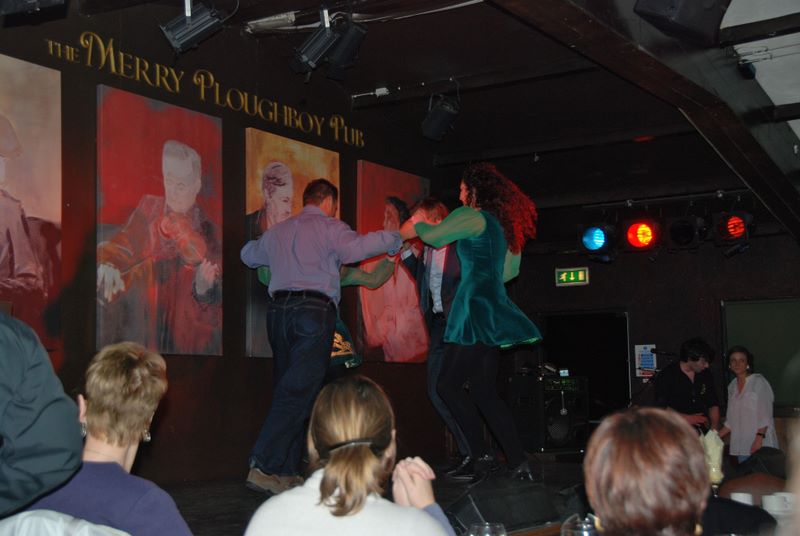
    After quite a while at the Storehouse, we headed back to the Croke Hotel and checked in for our last night in Ireland. If you remember from a few blogs back, we had been promised an evening of Irish music and dancing due to a miscommunication with the Dublin City Tour company. Well, we were picked up from our hotel and transported to the Merry Ploughboy Pub in the suburbs of Dublin. Along the way, we stopped at several different hotels in town and picked up others who were going to the show. We had a great conversation with the bus driver and, at one stop, we picked up one of the Merry Ploughboys himself. He provided us with a very spirited running conversation and description of the areas we were driving through. He also answered our questions about everyday life in Ireland. By the end of the trip, we had a new friend. 


So, this is a sweet deal. They own the pub, provide the meals, and the entertainment. There were probably 50-75 people in the pub. Countries like Russia, Norway, Germany, Turkey, and France were all represented by tourists in the crowd. I think Barb and I were the only Americans present. We were led to our table that was front row just off to the right of the stage. Dinner was fantastic and the show began. The boys played rousing Irish folksongs, ballads, and jigs. 


    During intermission, Owen (the bandmember that had ridden the bus with us), came over and chatted with us. He wanted to make sure that we were having a good time (we were). We had a great conversation. It was like we were the only ones in the Pub. After the brief intermission, we were treated to a local step dancing troupe (you know, like Riverdance). What can I say about that, it amazes me to watch them. 


    Then it was time for audience participation and, yes, I was nabbed. Here is my one (and ONLY) public Step Dancing. 


    The Ploughboys came back for a final set and the evening ended all too soon. This was a fantastic evening of traditional Irish music and dancing. I can’t think of a better way to end our trip and it left us with many great memories. In the long run, it was good fortune that we missed our Dublin City tour. This was something we would never have known about and are glad that we didn’t miss it. 

Tuesday, March 29, 2011

Cliffs of Moher & Ashford


    It rained overnight, but this morning the clouds began to break and we saw blue skies. Today is the longest day in terms of miles to travel. We are going from Dingle all the way north of Galway to a little village called Cong. Here we are to stay in a real Castle! 
    There are two ways to get where we’re going. One is through Limerick and overland northwards. The problem is, this bypasses another well known Irish sight, the Cliffs of Moher. Like Torc falls, the Cliffs of Moher are frequently seen in books on Ireland. Their sheer imposing forms, constantly being battered by the North Atlantic, are a proud National Heritage. In order to see them, and still have some daylight left to roam the castle, we decided to take the ferry from Tarbert to Kittimer. This short 1 1/2 mile trip over water, cuts out almost 100 miles of road travel! It also keeps us on the western coast where we want to be. 


    That’s our “roller skate” third from the right. 


    Barb wants this as our new summer home. 
    
    After a relatively uneventful drive we arrived at the Cliffs. When we were here in 2003, it was a small parking lot, no admission fee, and you could literally crawl out to the very edge of the 600 foot cliffs and look down. Since that time, they have moved the parking lot across the road and added an admission gate. They have also built an eco friendly visitors center and restaurant into the hills leading up to the cliffs. They have surrounded the edge with large stones to keep the dumber tourists back from the unstable ledges. 


    Here you can see some of the more adventurous (i.e. dumber) tourists. Every year portions of the ledges drop with no warning. Not sure how many of these folks drop with it, but I wouldn’t want to be one!!


    We left the cliffs and headed towards Galway. It was a long day and we were tired. We turned into the entry gates and were enthralled. This is just the entry. It led to a road that wandered for another mile or so of manicured grounds and forest until we came in sight of the castle itself. 


    This place was owned (up until just recently) by the Guinness family (of beer and world record fame). It hosted King George of England in the early 1900’s. It is the ultimate in luxury treatment. We were met by a bellman in the parking lot who delivered our bags to the lobby and parked our car. Once in the lobby, we were met by Grace at the reception desk. She checked us in, made our dinner reservation, then took us on a quick walking tour of the castle. She then led us to our room and made sure that we were comfortable.  We hadn’t been in the room more than a few minutes when the phone rang and it was management calling to make sure that everything was up to standard and that we were satisfied with our accommodations. We walked through a hallway where there were photos of past dignitaries and celebrities who had stayed there. Robin Williams, Brad Pitt, Ronald Reagan, and the Prince of Wales to name a few. We were definitely above our station here!! 
    A stroll of the grounds revealed unbelievable manicured gardens, tennis courts hidden in the trees, a falconry where you could learn the art of flying falcons, and a boat dock where you could rent kayaks or small row boats. Further down the road was a heliport, an equestrian center and large golf course.  


    Inside was regal and rich, dark woods.


    Dinner was a coat and tie affair. Since I had neither, Grace came to the rescue and provided me a coat from the castle stores and then found me a nice tie to match my shirt. So now, properly attired, we went to dinner. Again, very upper class. Two waiters for our table and multiple courses for the meal. We thoroughly enjoyed it. After dinner, I returned my borrowed coat and tie and we strolled the grounds. It was now after sunset and the castle was wrapped in the low glow of lights that lined the pathways. Tomorrow it’s back to Dublin and only one more day in Ireland. This trip has gone by wayyy to fast. This is a good way to end our adventure in the countryside!

Monday, March 28, 2011

Cahirsiveen to Dingle


    This morning, after another fantastic Irish breakfast, we worked with Kathleen to straighten out the whole voucher confusion. She was very helpful and let us use her phone to get things worked out with the Irish Travel folks. She also let us call Christina to let her know that all was worked out. What a nice lady!! 
    We left and today was planned a short travel distance day, but planned for a full day of sightseeing. We have only traveled a third of the Ring of Kerry and we also wanted to see the Killarney National Park. From there the plan called for us to drive up to Tralee and enter the Dingle Peninsula for the short trip to our next B&B in the town of Dingle. We were here on our last trip and we really love this part of Ireland. The views are always spectacular and the people are so friendly. 
    In the small town of Waterville, there stands a tribute to Charlie Chaplin. Seems that he stayed here frequently during his lifetime. 


    One of the things that is interesting is the stone fences. There is so much rock that you have to find something for it once you’ve cleared the land for farming. The answer was to make fences with it. All through the Ring, you can see patchwork hills, separated with stone fencing. 


    And of course, the locals always come to check you out if you stop by the side of the road...


    The National Park is magnificent, even this early in the season. The trees are beginning to bud out and many flowers are in bloom. Tucked away in the Park is Torc Falls. This is a very popular tourist site in the summer and pictures of the falls are frequently seen in travel books and brochures. 


    From here we took the short drive into the Dingle Peninsula. Here there are more spectacular cliffside panoramas leading up to the fishing village of Dingle. 


    The village is a popular tourist site in the summer and a hub of fishing activity year round. The brightly painted shops are quaint and the pub food is excellent!


    This part of Ireland prizes its Irish heritage and Gaelic is the predominant language spoken. 


And its translation...


    Just outside of town begins the Slea Head drive. This road follows the Peninsula coastline and returns along the base of the mountains to Dingle. It was cloudy and overcast when we drove it, but it just adds some mystique to the views. 


    Then, as is our habit this trip, we settled down in the commons room and read until long after sunset. We enjoyed the views and the warmth of the fireplace. We also took some time and chatted with others who were staying the night and had come down to visit.