Wildwood Bayou 2016

Wildwood Bayou 2016

Monday, April 25, 2011

Biltmore Estate


    I have finally found the home into which I will settle down and retire (see photo above). It has 4 acres of floor space, 250 rooms, 43 bathrooms, 65 fireplaces, three kitchens, two indoor bowling alleys, and an indoor swimming pool. The surrounding grounds include a 250 acre wooded park, five pleasure gardens, and a fully operating winery. Currently owned by the Vanderbilt family, I’m sure that they wouldn’t mind me living there. I don’t take up too much space and would hardly be noticed. Plenty of room to unobtrusively park the motorhome and jeep. 
Oh well, I can dream....
    We did visit the estate and it is amazing!  The structure is built of stone and steel, no framing of wood. It was designed as such to be fireproof. The interiors are paneled in rich woods and silks, so they could burn, but the structure is solid. George W. Vanderbilt III completed this building and welcomed his family and friends on Christmas Eve 1895. It has running water and electricity, a rarity in its day. Mr. Vanderbilt engaged two distinguished designers of his day: Richard M. Hunt, the architect that designed this home and several other Vanderbilt mansions along with the main facade of the Metropolitan Museum of Art in New York and the pedestal for the statue of Liberty; Frederick L. Olmsted was the landscape architect that designed all of the gardens and grounds on the then 125,000 acre estate. Olmsted was also the designer of Central Park in New York City and the US Capital grounds. I can’t begin to cover the history of the place, but suffice it to say, it is still owned by the Vanderbilt family and now they allow the public to see how the estate looked at the beginning of the 20th Century. We spent about 6 hours touring, but could have easily spent days. Just a word of warning, if you want to see this place, bring your wallet! Admission is not cheap and all but the self guided tour costs upwards of $17 per person. (You can’t see everything on the self guided tour either. You have to take several of the other offered tours to see everything.) Interior photography was not allowed, so the interior shots are from a pictorial guide we bought. That being said, it is a fascinating step back in time and history to tour this estate. The gardens were just coming to life. The azalea bushes were in full, bright bloom.  The tulips were just finishing and the roses were just beginning budding. It was fun to just wander and soak up nature.


    On the approach road from the gate to the main house. This is a three mile approach where there is a different landscaping feature at every turn (by design).


    The former stables now are stalls in the Stable Restaurant. Cute idea. 


    Exterior of the former stables.


    The main entry to the home. Note the angled windows on the left. These follow the curved Grand Staircase that leads to upper rooms. 


    The Vanderbilt initial is prominent in several places on the house. Makes it a possible sticking point for resale. 


    Inside the banquet hall. Seven stories tall! Notice the triple fireplace.


    The game room where the men would go for sport and socialization. The custom made billiard tables have three sheets of slate each weighing 900 lbs apiece.


    The library. Notice it is two stories high, with a spiral staircase to get to the upper level. The walkway goes behind the fireplace. 


    The indoor pool (without water). The lights around the bottom edge of the pool are original. 


    View from the covered walkway out back. 


    The pergola walkway to the Gardens.


     The Conservatory and walled garden.


     Shrub garden entrance.


Entrance to Azalea garden.


    Just some of the Gardens. 
    Then just a short three mile drive away is the old farm and Dairy. This is also the location of the Winery, newly built Inn and restaurants. 


    Inside the stables.


    The Barn/Stables were unique as it was built as a part of a large oval wall where the animals could be brought into if necessary. You could also drive into and out of the barn easily to facilitate all manner of farm support deliveries.


    Being Spring, the baby goats are out in full cuteness. 


    Just one of the two big Belgian Draft horses who help out around the grounds.  This one was Bert.

Thursday, April 21, 2011

Charleston, SC- Tea Garden


    Today we took a break from the ordinary and ventured a few miles outside of Charleston to visit America’s only Tea Garden ( www.charlestonteaplantation.com ). It is from here that American Classic Teas are grown and made. There are currently 127 acres filled with tea plants. From  1963 until 1987, the plantation was a research site for the Lipton Company (out of England). They were experimenting and trying to find how and what types of tea could be grown in America. In 1987, the property was purchased by a master tea taster and the American Classic teas were developed. In 2003, the Plantation was purchased by the Bigelow family who were tea producers in their own right. Just recently, the Tea Plantation has a contract with a major national grocery store and will eventually be on shelves across the country. They will start small, only in the southeast at first, then, as production increases, will expand throughout the nation. They offer a trolley tour of the grounds where you can see the production in action. Right now, the tea bushes are waking from a winter dormancy and should be ready for the first cutting harvest around the first of May. Then they will be cut weekly through the summer and into late October. 


    The new growth leaves are the only thing that they harvest and use. The top 3-4 inches are cut using a one-of-a-kind machine they nicknamed the “Green Giant”. It was designed and built on the property using parts from tractors and tobacco cultivators. 


    There is a set of cutting blades, that look similar to a big set of electric hedge clippers in the lower center of the vehicle. Large blowers are mounted forwards of the blades and blow the cuttings up the chute and into the collection basket at the end. 


When full, this basket is dumped into a pickup truck and hauled to the factory (on property). In the rest of the world, tea is harvested by hand, much as it has for centuries. This machine does the work of 500 field hands! In fact, the Plantation has only 4 employees that manage and harvest the tea. They have a couple of trolley drivers and four ladies in the gift shop/reception center. After harvest, the tea leaves are brought in to what is called the Withering bed. 


    The leaves are spread out and large blowers circulate air around the leaves in order to dry them out. 


    They next follow up a conveyor belt where they are fed into a series of grinders and the tea leaves are turned into a mulch like product. This breaks up the plant cells and allows chemical processes to occur which affects the flavor of the tea. This product is then spread onto another conveyor belt and run into the dryer. The type of tea desired determines how long it stays in the dryer. Black tea stays for 50 minutes. Oolong tea stays for only 15 minutes. Green tea skips this drying step altogether. 


    The dried tea is then sifted twice to remove any bits of stem and debris. The end result is the tea that is ready for sale. Loose tea is canned and ready for sale or shipment on premise. Tea for tea bags is sent to the Bigelow processing facility in the Northeast for packaging and sale. 
    After the tours, you are welcome to stroll around the grounds or visit the gift shop, where you can sample both hot and cold teas to your hearts content (bathrooms are conveniently located just outside).
    On the way back to the motorhome, we stopped by Angel Oak Park. Here is a 300-400 year old Live Oak tree. This monster is as wide as it is tall and is easily as big as a two story home. The branches spread out and touch the ground in many cases. You can see the size of the trunk in comparison to me. You see the Live Oak trees all over the southern coastal areas. The wood is very strong and was a prized component for many wooden ocean going ships. The USS Constitution (Old Ironsides) was made from Live Oak. The canopy created by these trees makes all of the beautiful lanes that you think of when you think of the old South. Point of trivia, the Live Oak gets its name from the fact that it always has green leaves in abundance. While other oak trees go dormant and loose their leaves, the live oak always has green leaves. 


    Back early to the campground today and we are packing up in order to head further northwards tomorrow. 

Wednesday, April 20, 2011

Charleston, SC - Boone Hall


   A short way outside of Charleston is the Boone Hall Plantation. It claims to be America’s most photographed plantation. It is very impressive. The Avenue of Oaks (as you come into the Plantation), is a 3/4 mile long row of 75 live oak trees. These trees are around 300 years old and are magnificent. In fact, if you’ve seen the movies “North and South” (with Patrick Swayze; it served as Mont Royal) or “The Notebook” with Halle Berry, or “Queen”, Alex Haley’s sequel to “Roots”,  then you’ve seen Boone Hall. 


    Looking down the Avenue of Oaks from the “Big House” (pictured above).
    The gardens that surround the Plantation have one of the oldest collections of antique roses that date back more than 100 years. It was very fragrant and in bloom when we visited!


    The Boones of Boone Hall were not notable in and of themselves, but two of their sons have a place in history.  John Rutledge grew up to become Governor of South Carolina and an author of parts of the US Constitution. John’s brother, Edward, was the youngest signatory of the Declaration of Independence. Another item of note, Boone Hall Plantation produced the bricks that were used in the building of Ft. Sumter and other Charleston landmarks! The Plantation is on the National Register of Historic Places. The property has the original brick smokehouse used by the Plantation since the 1700’s and nine original slave cabins (built of brick, not wood) that were home to the skilled slaves that supported the Plantation (below).  These cabins are located near the main home, and housed the blacksmith, seamstress, cooks, and other skilled laborers that were required to support the house in its day to day operation. The field hands’ cabins were made of wood and were located closer to the fields where they worked. None of those cabins survive (but we did see some that were similar back during our visits to the plantations around New Orleans)


    What is very interesting is, in each of the cabins, they tell a successive story of the history of slavery and Civil Rights in America. Artifacts and other multi-media present a very informative part of this chapter in our history. 
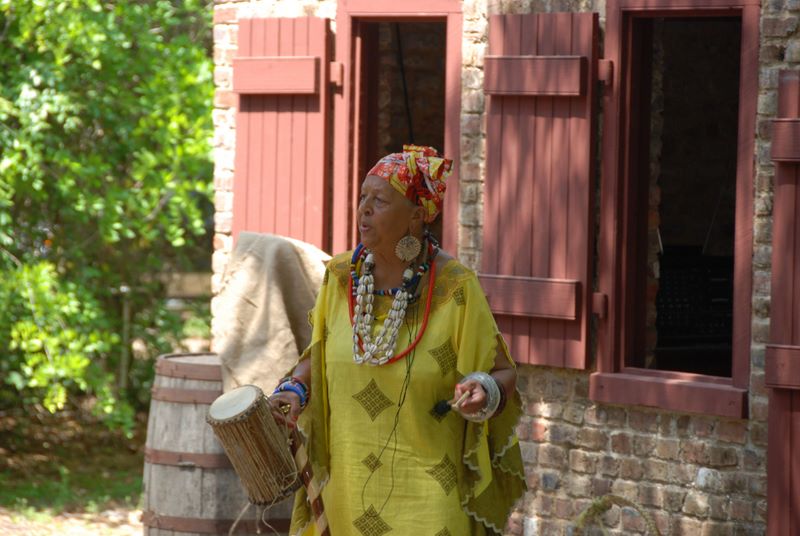
    There is a presentation on the Gullah Culture. The Gullah is the culture that is unique to the low country slaves in the South Carolina area. We didn’t get to hear the whole presentation, but what we did see was very interesting and informative. 


    The walls that surround the main house are also made of bricks made by the slaves. This intricate and elaborate curving of the wall is very impressive. 


    The folks here have done a magnificent job of showing life on a plantation from both sides, master and slave, and have done it in a forthright and unvarnished manner. I would recommend this place to anyone. It is a very informative and interesting place to visit. 


Charleston, SC - Ft. Sumter


    The last couple of days we have spent in Charleston, SC. This town is known for many things, but is probably most well known for the fact that the first shots of the Civil War were fired here at Fort Sumter. At 4:10 am on April 12, 1861, the Confederates opened fire on the fort commanded by Union Major Robert Anderson. (Anderson's second in command was a man by the name of Abner Doubleday. Abner has been credited with creating the game of baseball. This claim has never been substantiated but that’s what I always heard.) 34 hours later, after significant bombardment, Major Anderson surrendered the fort and was allowed to return to the North with his troops. The fort stayed in Confederate hands until February 17, 1865! During this time, it is estimated that the Union forces hurled seven MILLION pounds of metal into the fort and it resulted in only 52 killed and 267 wounded. The fort was in and out of service as a military installation until 1948, when it was transferred to the National Park Service. 
    The fort stands on a man-made island at the mouth of the inlet into Charleston.  You have to take a shuttle boat out to the island. The trick to this is, the boat is operated under the National Park Service vendor and you board at the Visitors Center. You take the trip out, have 1 hour to explore the Fort, visit the small museum, and take in the sights, then you have to get back on the boat and return to the Visitor’s Center. We got there in the middle of the week, in mid April (no spring break, or holiday, or any other reason for mass quantities of tourists). There were at least a hundred folks waiting in line to buy tickets to the shuttle! My hints on how best to see the fort if you’re interested.... You can book your shuttle online. DO IT THAT WAY! You can sign up the night before and be assured of a reservation. Next, select the 9:30 shuttle. It is the first one of the morning. You have to drive into the heart of Charleston and the traffic is not the easiest to negotiate. If you get there early in the morning, you can use the metered spots along the road outside of the visitors center ($ 0.25/20 minutes) or use the garage nearby. Take the printed confirmation of your online reservation to the window for your tickets. For extra fun, wait until 9:00 or so, when they announce that the 9:30 shuttle is full, then smile as you walk past all those poor unfortunate souls who didn’t reserve online, on up to the ticket booth and get your ticket and go on in. 


    The US Custom House down the street from the Visitors Center. 


    Ft. Sumter on the approach. 


    Along the way, you may get lucky enough to be led by some playful dolphins. 


    The Fort itself used to stand 55 feet above the water in three stories. Time, and Union bombardment have reduced it to its current form. 


    One of the many gun emplacements. 


    There are some places where cannonballs are still lodged in the wall!


    Charleston in the distance as seen from atop the Fort. 


    Near the Visitors Center is the Ravenel Bridge. An impressive structure. The Aircraft Carrier USS Yorktown is berthed and on display on the right.